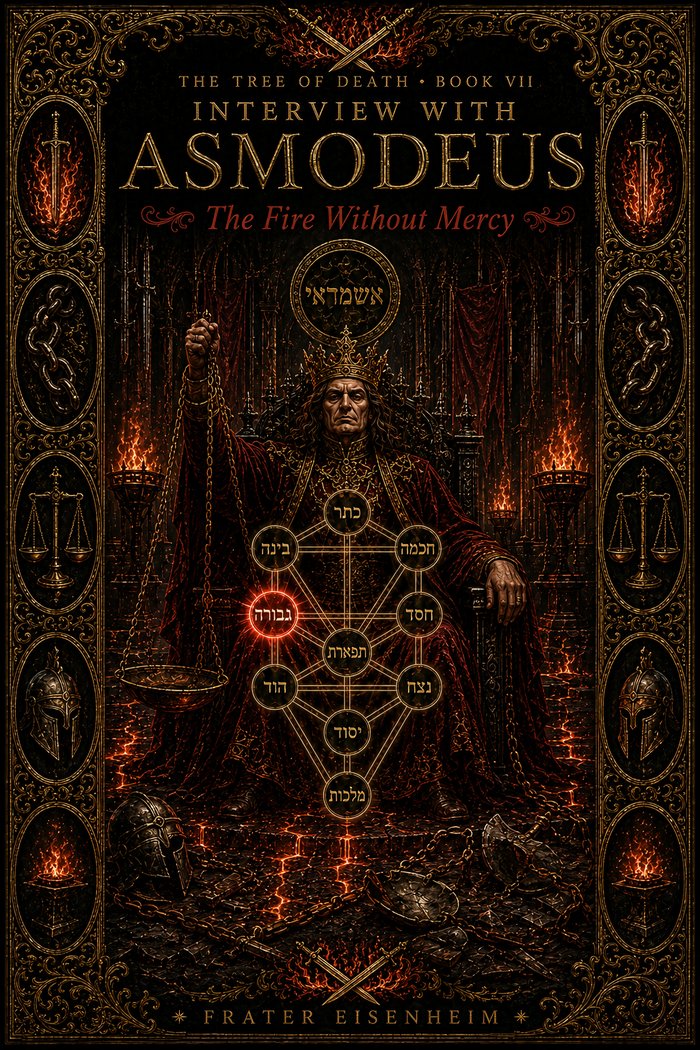
Asmodeus
The Fire Without Mercy
'“When does strength cease to protect life and begin to desire its destruction?”'
There is a chamber of iron and embers where everything is a challenge — even the silence provokes. A sword rests upon black stone, not sheathed but displayed, as if inviting one to test its edge. There dwells Golachab, those who burn in conflagration, the shadow of Geburah, the severe hand that cuts away evil to preserve life. The name this loveless severity takes, when it grinds its teeth and speaks, is Asmodeus — the twin and opposite brother of Astaroth: where she drowns in limitless sweetness, he burns in rigor without mercy. Two pillars of the Tree, each alone in ruin.
In the seventh volume of The Tree of Death, Frater Eisenheim sits before the intelligence of combat — the one that turns every question into a challenge and every wound into a war, and calls weak whoever retreats before it, knowing that many men do out of pride what they would never do out of malice. Asmodeus neither seduces nor charges: he provokes. Each answer is a hook cast at the questioner's pride — until the interviewer learns the one thing that saves the blade from its own edge: not to drop it, not to brandish it, but to temper it, cooling it of its fury and returning it to the service of protecting, not of wounding.
This is not a manual. It is a blade — and what it keeps is the exact distance between the strength that defends life and the strength that only wishes to see it burn.
Subscribe to read View the full seriesReading protected by subscription. Digital format (e-book).