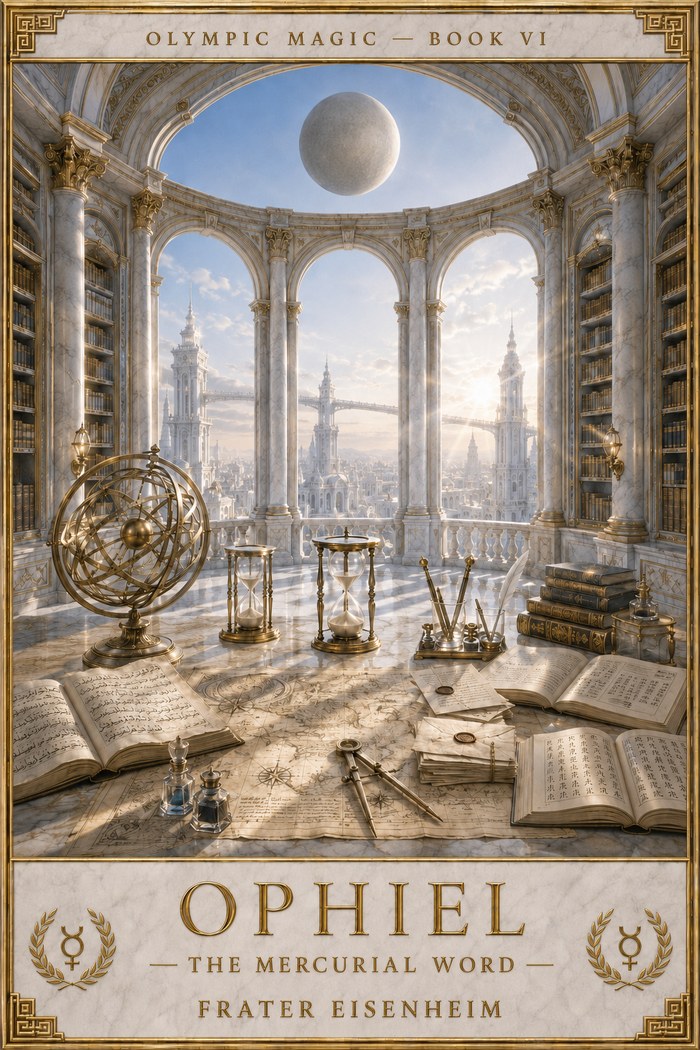
Ophiel
The Mercurial Word
When do the word and intelligence cease to serve the truth, and man comes instead to use them to manipulate and to negotiate the soul, mistaking the force for the Source?
One neither climbs to this dwelling nor descends to it: one crosses. The house of Ophiel is a library suspended in the air over a city that is waking, and one reaches it by thin bridges of silver that join bright towers and sway a little underfoot — enough that no one crosses them running, because to the house of the word one does not come in haste. Within it is the very beginning of morning: silver light from the east in blades, tables covered with maps, sealed letters beside letters already opened, running hourglasses, metal pens in glass inkwells, and books open in many tongues. There keeps watch the sixth of the seven governors the Arbatel says were set by God over the planets — Mercury, keeper of the word, of intelligence, of science, and of communication. The name that intelligence takes, when it consents to speak, is Ophiel.
In the sixth volume of Olympic Magic, Eisenheim sits at the table and asks him for nothing — neither eloquence, nor gain, nor the power to convince. Across ten topics and a whole morning, Ophiel reveals the luminous force entrusted to him — the word that binds, the intelligence that understands, the science that orders, the communication that draws near — and warns, always from the side of the light, about the human shadow that counterfeits it: the cunning that replaces uprightness, the commerce of the soul, science without reverence, the scattered mind, and the swift lie. Each topic closes with a Note of Discernment, in the author's voice, that separates the word anchored in truth from the one that rests only on the speaker.
There is here no rite, seal, formula, or evocation — and it is not fiction: it is a listening set in the form of a dialogue, a contemplation, not an operation. Ophiel is neither courted nor constrained; it was God who granted the entrance, and the spirit itself refuses the knee and points away from itself, because every true word belongs to the One who writes it. What the book unmasks is not the celestial messenger, but what men make of the word when they take it for their own merit and for the Source.
Sixth volume of Olympic Magic — Interviews with the Seven Spirits of the Firmament. Upon the foundation of Saturn, the expansion of Jupiter, the sword of Mars, the light of the Sun, and the garden of Venus, rises the library of Mercury — the swiftest of the heavens, and the nearest to the mouth of man, where the shadow is so light that it passes for intelligence.
The same word can bind or deceive, the same intelligence can understand or maneuver — and what separates them is the far bank: the one fastened to a thing outside the speaker, or the one that rests only on himself.
Subscribe to read View the full seriesReading protected by subscription. Digital format (e-book).