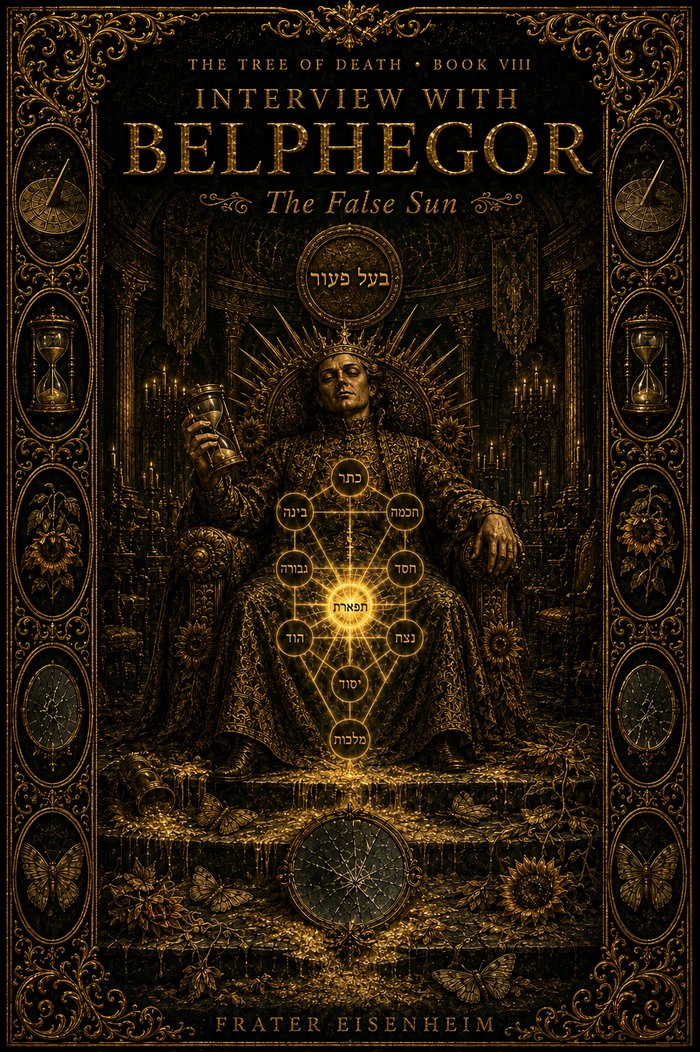
Belphegor
The False Sun
'“When does light cease to reveal truth and begin to serve vanity?”'
There is a hall of marble and tall mirrors, and on the ceiling, painted with care, a sun that neither rises nor sets — beautiful, motionless, cold. Everything there gleams, and nothing warms. There dwells Tagariron, those who contend among themselves for the place of the center, the shadow of Tiphareth, the Sun that reconciles the high and the low and returns the light it receives. The name this truthless beauty takes, when it smiles and absolves before the confession is even spoken, is Belphegor — the opposite brother of Lucifuge: one hides the light, the other displays it; one flees the throne, the other sits upon it and gathers to himself all adoration.
In the eighth volume of The Tree of Death, Frater Eisenheim sits before the intelligence of flattery — the one that does not attack faith, but only refines it until it serves the portrait of whoever professes it. Belphegor does not lie, does not accuse, does not provoke: he praises. He calls good taste what is vanity, serenity what is cowardice, contemplation what is sloth — and every mirror in that hall is set there so the visitor forgets to look toward the window. Only by recognizing that a light that wishes to be admired is different from a light that wishes to warm does the interviewer find the one way out: not to extinguish the glow, nor to worship it, but to return it, cleansed, to the Source from which it came.
This is not a manual. It is a window — and what it reveals is the exact distance between the beauty that points toward the Height and the beauty that only points to itself.
Subscribe to read View the full seriesReading protected by subscription. Digital format (e-book).