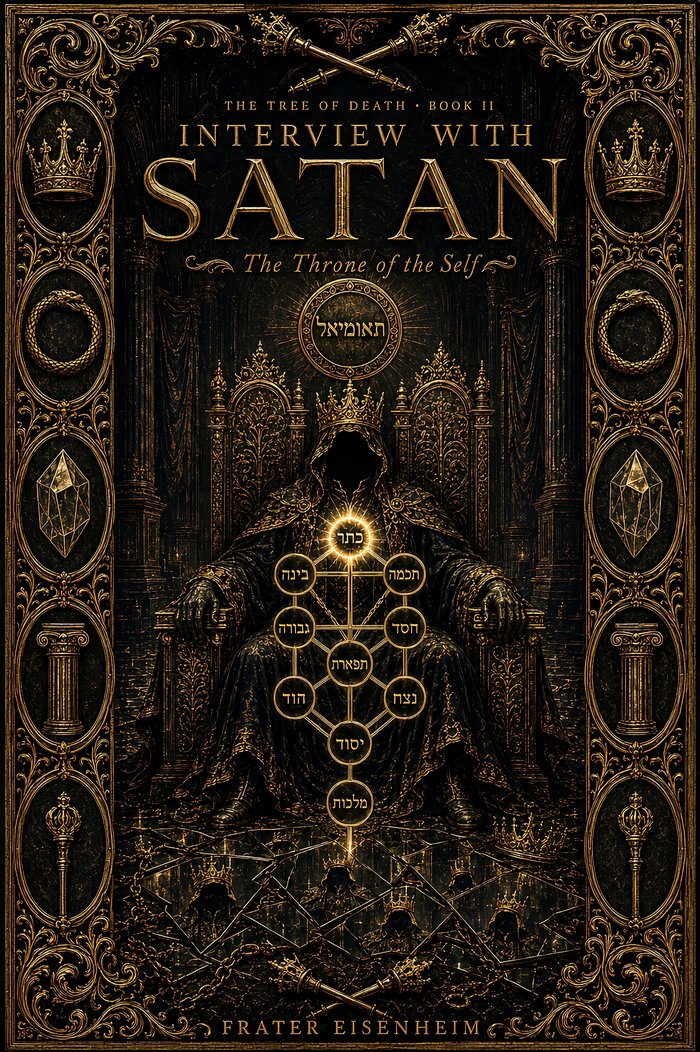
Satan
The Throne of the Self
When freedom separates itself from the Source, is it still freedom, or has it already become exile?
There is a room with two identical chairs, face to face — and that very equality is the first warning. Where there should be a host and a guest, there are two thrones, and the symmetry weighs like a threat: the word "I" itself, laid upon the dark stone table, lays claim to a seat. There dwells Thaumiel, the shadow of Kether — Unity broken into two thrones that hate each other. The name this rupture takes, when it speaks, is Satan.
In the second volume of The Tree of Death, Frater Eisenheim sits as an equal before the one adversary who never lies — he only accuses, and the accusation is more dangerous than the lie, because it tends to be true, only incomplete, only without mercy, only bent toward separation. Satan offers no power: he offers a twin throne, the promise of an absolute autonomy, and calls that exile freedom. Each answer he gives is a border drawn across the middle of the room — and the only possible victory is neither to defeat him by force nor to yield him the place, but to remain standing before the empty chair he always, always leaves available.
This is not a manual. It is a mirror split down the middle — and what it reflects is the exact distance between resisting the false and kneeling to the true.
Subscribe to read View the full seriesReading protected by subscription. Digital format (e-book).