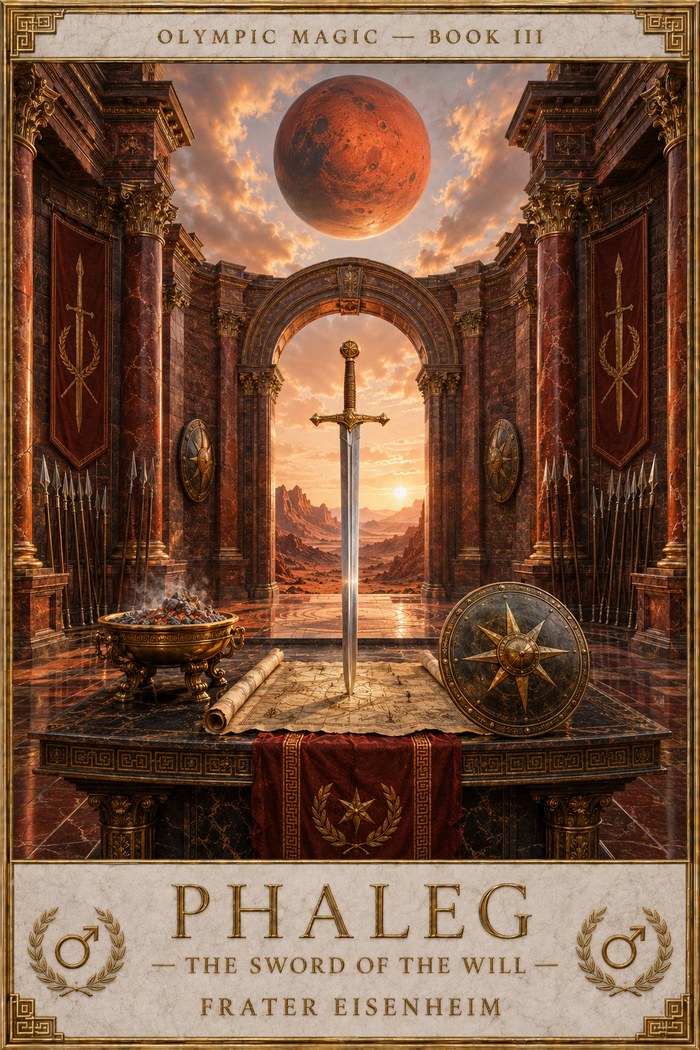
Phaleg
The Sword of the Will
When do force and courage cease to protect life, and man comes instead to make use of them to dominate and to win, mistaking the force for the Source?
One does not rest in this dwelling: in it one stands. There is a fortress of red stone raised beneath the ruddy star of Mars, harsh ramparts where the wind whistles among planted spears and hanging shields, and a brazier that burns in the courtyard without consuming itself — not to warm, but to remember that all force is given to guard, not to burn for itself. There keeps watch the third of the seven governors that the Arbatel says were set by God over the planets — Mars, keeper of force, of courage, of discipline, and of combat. The name that intelligence takes, when it consents to speak, is Phaleg.
In the third volume of Olympic Magic, Eisenheim sits before him and asks him for nothing — neither victory, nor vengeance, nor power to win. Across ten topics and a whole afternoon, Phaleg reveals the luminous force entrusted to him — the vigor that protects life, the courage that confronts evil, the discipline that forges character, the firmness that sustains the just — and warns, always from the side of the light, about the human shadow that counterfeits it: the war waged within against oneself, anger taken for fuel, the discipline that crushes instead of raising up, violence that justifies itself, courage turned to rashness, and the sword raised to dominate instead of to defend. Each topic closes with a Note of Discernment, in the author's voice, that separates true force from the fury that imitates it.
There is here no rite, seal, formula, or evocation — and it is not fiction: it is a listening set in the form of a dialogue, a contemplation, not an operation. Phaleg is neither courted nor constrained; it was God who granted the entrance, and the spirit itself refuses the knee and points away from itself, because all force belongs to the One who gives it. What the book unmasks is not the celestial messenger, but what men make of force when they take it for their own merit and for the Source.
Third volume of Olympic Magic — Interviews with the Seven Spirits of the Firmament. After the foundation of Saturn and the expansion of Jupiter comes the force of Mars — because it avails nothing to build and to grow if there is no vigor to guard what was raised, and no courage is safe in a soul that has not yet been settled or proven.
The same force can protect or crush, defend or conquer — and what separates them is the hand in which a man places the sword: his own, and it wounds; God's, and it guards.
Subscribe to read View the full seriesReading protected by subscription. Digital format (e-book).