Phul
The Moon of Waters
When do dream and imagination cease to reflect the truth, and man comes instead to drown in his own reflection, mistaking the force for the Source?
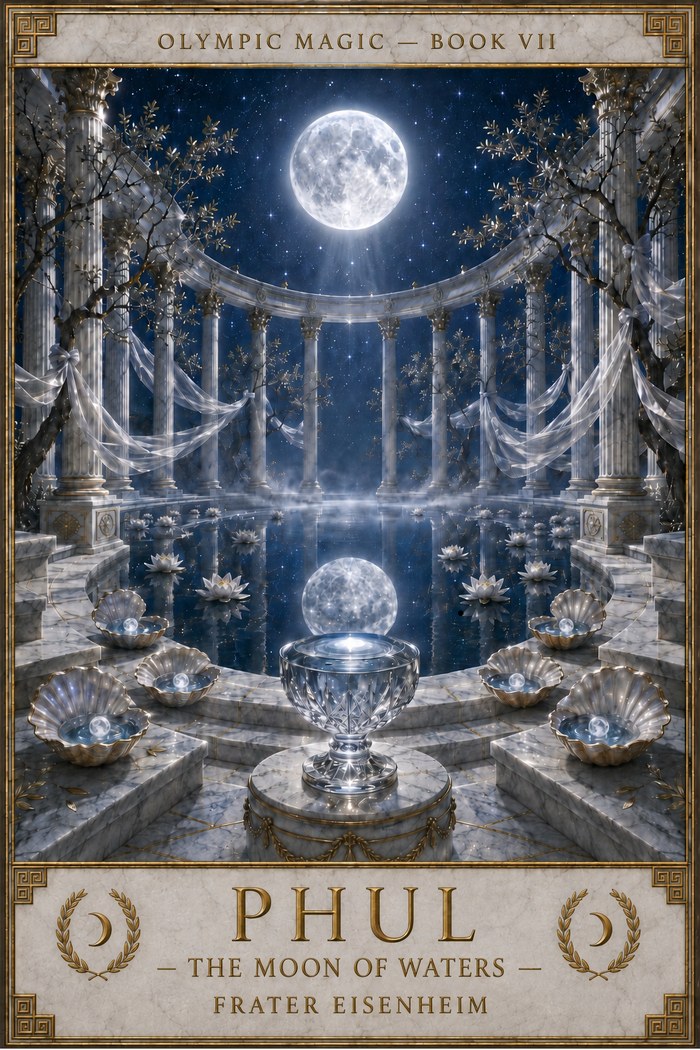
One neither climbs to this dwelling nor crosses to it: one descends. A wide stair of pale stone, worn in the middle of the steps by the use of very many feet, leads down to the margin of a perfectly circular lake, ringed by ancient columns all still standing — none fallen, none broken. Within it is always night, but a clear, silvery night one can read by: still water that reflects a second moon lying down, open shells each holding the whole moon in a little water, white flowers that do not move, a cup full above the rim without overflowing, and a fine mist that hides nothing and only softens the edges of everything. There keeps watch the seventh and last of the seven governors the Arbatel says were set by God over the planets — the Moon, keeper of the dream that translates, the memory that preserves, the imagination that reveals, and the sensibility that welcomes. The name that intelligence takes, when it consents to speak, is Phul.
In the seventh and last volume of Olympic Magic, Eisenheim sits on a step at the water's edge and asks him for nothing — neither dreams, nor visions, nor consolation. Across ten topics and a whole night, Phul reveals the luminous force entrusted to him — the dream that shows, the memory that gives thanks, the imagination that has compassion and hopes, the sensibility that accompanies without governing — and warns, always from the side of the light, about the human shadow that counterfeits it: the veiled intuition that is only neediness speaking loudly, the care that binds, nostalgia as a prison, and the lunar illusion in which a man drowns in his own reflection. Each topic closes with a Note of Discernment, in the author's voice, that separates the received image from the fabricated one.
There is here no rite, seal, formula, or evocation — and it is not fiction: it is a listening set in the form of a dialogue, a contemplation, not an operation. Phul is neither courted nor constrained; it was God who granted the entrance, and the spirit itself refuses the knee and points away from itself, because the Moon has no light of its own. What the book unmasks is not the celestial messenger, but what men make of the soul's mirror when they take it for the Source.
Seventh and last volume of Olympic Magic — Interviews with the Seven Spirits of the Firmament. Upon the foundation of Aratron, the breadth of Bethor, the sword of Phaleg, the light of Och, the garden of Hagith, and the library of Ophiel, the descent ends at the serene water in which all that came from the six earlier heavens is reflected, so that a man may at last see himself — and, seeing himself, lift his head.
The Moon has no light of its own, and it is exactly for that reason that it serves us: the day it seems to have a light of its own, it is no longer the Moon we are seeing, it is our own face within the water.
Subscribe to read View the full seriesReading protected by subscription. Digital format (e-book).