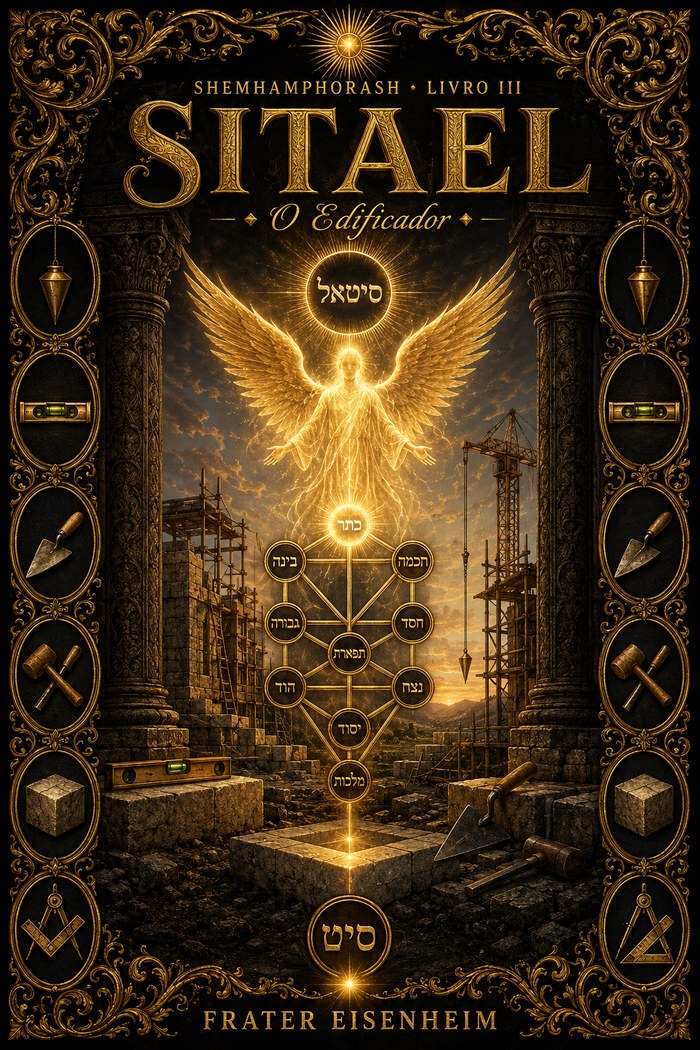
Sitael
The Builder
When does building cease to serve the good and begin to raise monuments to one’s own ego?
On a temple site opened upon the living rock at daybreak, with the first squared stones going up and the plumb line still hanging, Eisenheim sits before Sitael, the third of the seventy-two Angels of the Kabbalah, guardian of building and of nobility of soul. He does not come to ask for greatness, nor for a work, nor that his name should remain. He comes to ask one single thing, and behind it he brings everything he has ever raised in order to be seen: where, in me, did building cease to serve the good and turn into a monument to my own ego?
Out of that encounter is born a long contemplation on the virtue that founds cities and souls — the strength to build the good — and on the four shadows that imitate it to perfection. The vanity of greatness, which builds in order to be remembered and measures the work by the size of the shadow it casts. Pride, which bows before no one and calls strength what is merely an incapacity to serve. Building upon sand, which raises high and fast without going down to the foundation, and founds empires upon what does not hold. And the most intimate of them all, the monument to the self: the work that begins with God and ends with the builder’s name written in the stone.
Sitael answers as a luminous intelligence, servant of ELOHIM: it speaks only the truth, refuses all adoration, and returns every honour to the Source. It teaches that building is not the enemy — God is the first builder — but that every true work first descends to the rock, rises upon a foundation that is not seen, and returns purified to Him from whom every work proceeds. Because the hand that builds again in truth raises nothing greater: it raises the same stone, upon another foundation.
A literary, symbolic and initiatory work. There is here no evocation, rite, seal, operative psalm or formula — no answer of the angel is to be read as a method to be applied. The angel is not to be worshipped nor evoked: reverence belongs to God, and the angel is a messenger, not a destination. A faithful mirror, for whoever wishes to learn to build in truth.
Book III of the collection “Shemhamphorash — Interviews with the Seventy-Two Angels of the Kabbalah”.
Subscribe to read View the full seriesReading protected by subscription. Digital format (e-book).