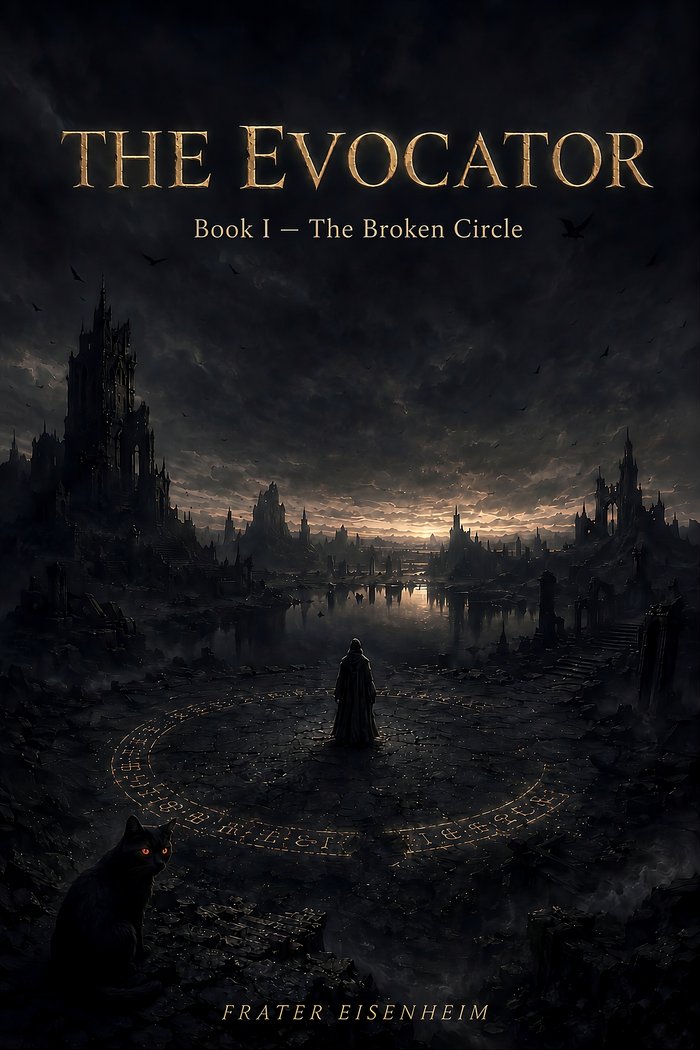
The Evocator — Book I
The Broken Circle
There was a time when men knew how to pronounce the Names, and the earth trembled to hear them.
There was a time when men knew how to pronounce the Names, and the earth trembled to hear them. That time is not over — it has only withdrawn to the upper floors of a few tall houses, where a handful still remember how it is done. In the highest of them lives the greatest of them all: Frater Eisenheim, the greatest living evocator, master of the seventy-two spirits of the Goetia — the kings, dukes, princes and marquises of the Ars Goetia —, lord of a knowledge that no man of his time would ever gather again. Thirty years of calling, questioning, noting and dismissing; entire shelves of notebooks mapping the far side of the veil word by word. And one rule beneath all the others, the rule the Circle carved into the floor exists to guarantee: the evocator calls, but does not go; he leans over the well, but does not fall. He stays on this side. Always on this side.
This is Frater Eisenheim's first novel — not a manual, but a story: the story of how the greatest of them fell. Because a man does not fall through what he fears — from what he fears, he flees; he falls through what he loves, when what he loves is taken from him, and the hole that remains has the exact shape of what he lost. Old Reb Zalman had warned him in two promises — never go down to the other side after the one death took; and do not remain with the art alone, find an anchor to pull you toward the world of the living. Eisenheim kept both. He found the most luminous anchor a man can have, and her name was Lalá — the woman who taught him, in a café, because of a bird, the one thing his art of binding and releasing powers had never given him: that some things can only be saved by letting them go. And it was through having had her, and loved her, and lost her, that the hole with the exact shape of a person opened in him — the hole that those below fill.
Because there is a powerful king, on the far side of the veil, who does not cast his line at random. He is a fisherman who studies the river for years, who knows each fish by name, who knows which of them carries an old hook already sunk and not yet pulled — and who has all the time in the world. When the widow of a portrait knocks at the door and asks "if you speak with them, then they know", Eisenheim keeps, without meaning to, the question he had spent thirty years not asking himself. And the Circle his master taught him to draw — not to protect him from the powers he calls, but to protect him from himself, from the hour when he himself would want to step out — begins, on that ordinary night, long before the misstep, to break.
The Broken Circle follows Eisenheim's descent into the kingdom of the seventy-two spirits: the crossing of the threshold and the city of shards, the meeting with a man made of stone who fell before him for not knowing how to let go, the unlikely company of a nameless shard who becomes guide and friend, and the terrible lesson of the black river, which takes what is loose and leaves what is kept — that to let go of the pursuit of the beloved is not to lose the beloved; that to renounce the hope turned outward is not to renounce love; that the river takes what one chases and leaves what one loves, and they are different things. It is a novel of occultism and grief, about names that bind and names that release, about the hunger the powers have for our lack, and about the only honest evocation left to us: to remember.
First book of the series The Evocator (the second in preparation). The story closes this volume without closing — like a broken circle, which by definition is a circle that has not yet closed —, on the threshold of the kingdom of music, before a magnificent king who offers, cheap and immediate, the answer to the whole search. What Eisenheim answers is the matter of Book II.
Subscribe to readReading protected by subscription. Digital format (e-book).