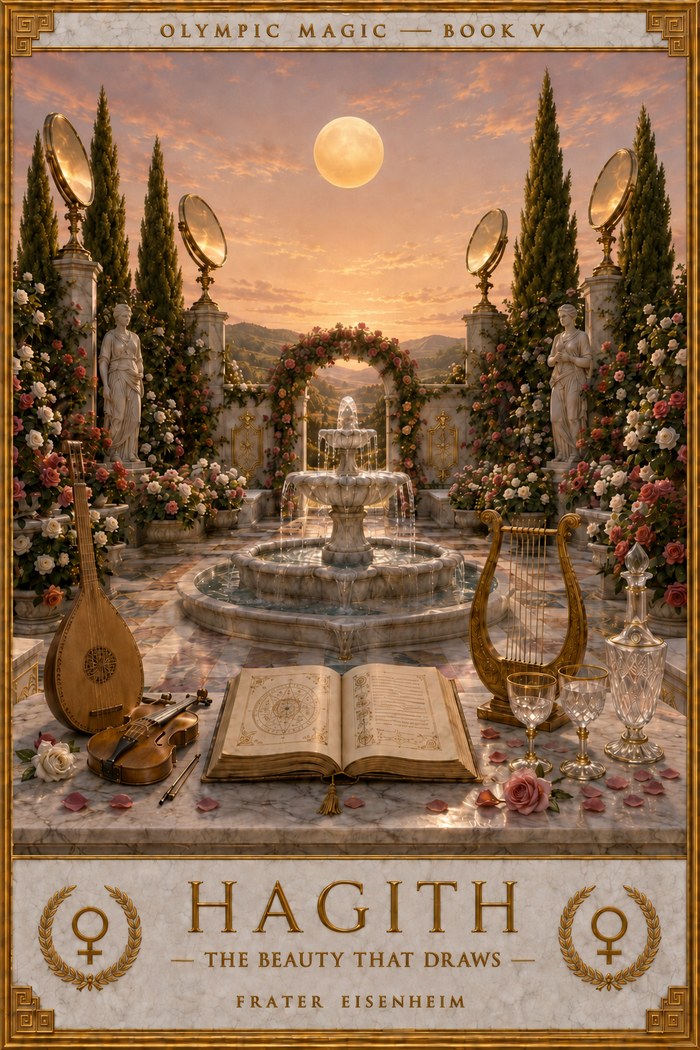
Hagith
The Beauty that Draws
When do beauty and love cease to reveal harmony, and man comes instead to use them to possess and to adorn the lie, mistaking the force for the Source?
One does not climb to this dwelling: one descends. At the bottom of a closed valley there is a walled garden, and one enters it by a single low door in a whitewashed wall covered with roses — so low that one must bend the neck to pass, made so on purpose, that no one might enter the house of beauty without having first bowed once. Within it is always dusk: fountains of running water that falls from basin to basin, white and red rose-bushes, mirrors of bronze tilted toward the sky — none turned toward the face of the one who passes — and, far off, over the wall, Venus, the star of evening. There keeps watch the fifth of the seven governors the Arbatel says were set by God over the planets — Venus, keeper of beauty, of love, of harmony, and of art. The name that intelligence takes, when it consents to speak, is Hagith.
In the fifth volume of Olympic Magic, Eisenheim sits at the edge of the fountain and asks him for nothing — neither love, nor beauty, nor pleasure. Across ten topics and a whole evening, Hagith reveals the luminous force entrusted to him — the beauty that reveals the invisible order, the love that unites, the harmony that reconciles, the art that raises up — and warns, always from the side of the light, about the human shadow that counterfeits it: the beauty that adorns the lie, the love that possesses instead of uniting, the pleasure that turns to flight, the seduction that governs, the harmony of façade, and the idolatry of appearance. Each topic closes with a Note of Discernment, in the author's voice, that separates the beauty which points beyond itself from the one that closes and rots in the hand.
There is here no rite, seal, formula, or evocation — and it is not fiction: it is a listening set in the form of a dialogue, a contemplation, not an operation. Hagith is neither courted nor constrained; it was God who granted the entrance, and the spirit itself refuses the knee and points away from itself, because all beauty belongs to the One who kindles it. What the book unmasks is not the celestial messenger, but what men make of beauty when they take it for their own merit and for the Source.
Fifth volume of Olympic Magic — Interviews with the Seven Spirits of the Firmament. Upon the foundation of Saturn, the expansion of Jupiter, the sword of Mars, and the light of the Sun, rises the garden of Venus — the sweetest and the most dangerous of the heavens, because it is the most beloved, and nothing is harder to let go of than a chain that gives pleasure.
The same beauty can reveal or imprison, the same love can unite or devour — and what separates them is the hand in which a man holds the force: open, that it may run; or closed, that it may rot in the palm.
Subscribe to read View the full seriesReading protected by subscription. Digital format (e-book).